

If you are comparing Coral AI pricing with DocuAsk, the first thing to know is that the public pricing evidence is uneven. DocuAsk publishes its current plans and trial terms. Coral AI's main website was unavailable when we checked on 4 August 2026, and recent third-party listings disagree about its paid price.
That does not mean Coral AI is the wrong choice. It means you should confirm the amount and billing period at Coral AI's checkout before making a purchase. This guide separates what can be verified from what still needs checking, then compares the two products on the work that matters: asking questions, tracing answers to source pages, handling multiple documents, and testing the product before you pay.
Coral AI and DocuAsk pricing at a glance
| Question | Coral AI | DocuAsk |
|---|---|---|
| Is a free option reported? | Yes. Recent listings describe a limited free tier, but we could not verify the current allowance on Coral AI's own site. | Yes. The public PDF trial accepts one public PDF and returns a cited answer without signup or a card. |
| What is the paid price? | Unclear. One pricing tracker reports $12 per month billed yearly, while software directories list $30 per month. Confirm at checkout. | Archive Alchemist is $14.99 monthly or $12.49 per month billed yearly. Quantum Quill is $24.99 monthly or $19.99 per month billed yearly. |
| Is a card needed to test it? | Not independently verified in this review. | No card for the public PDF trial. A card is required for the 15-day paid workspace trial. |
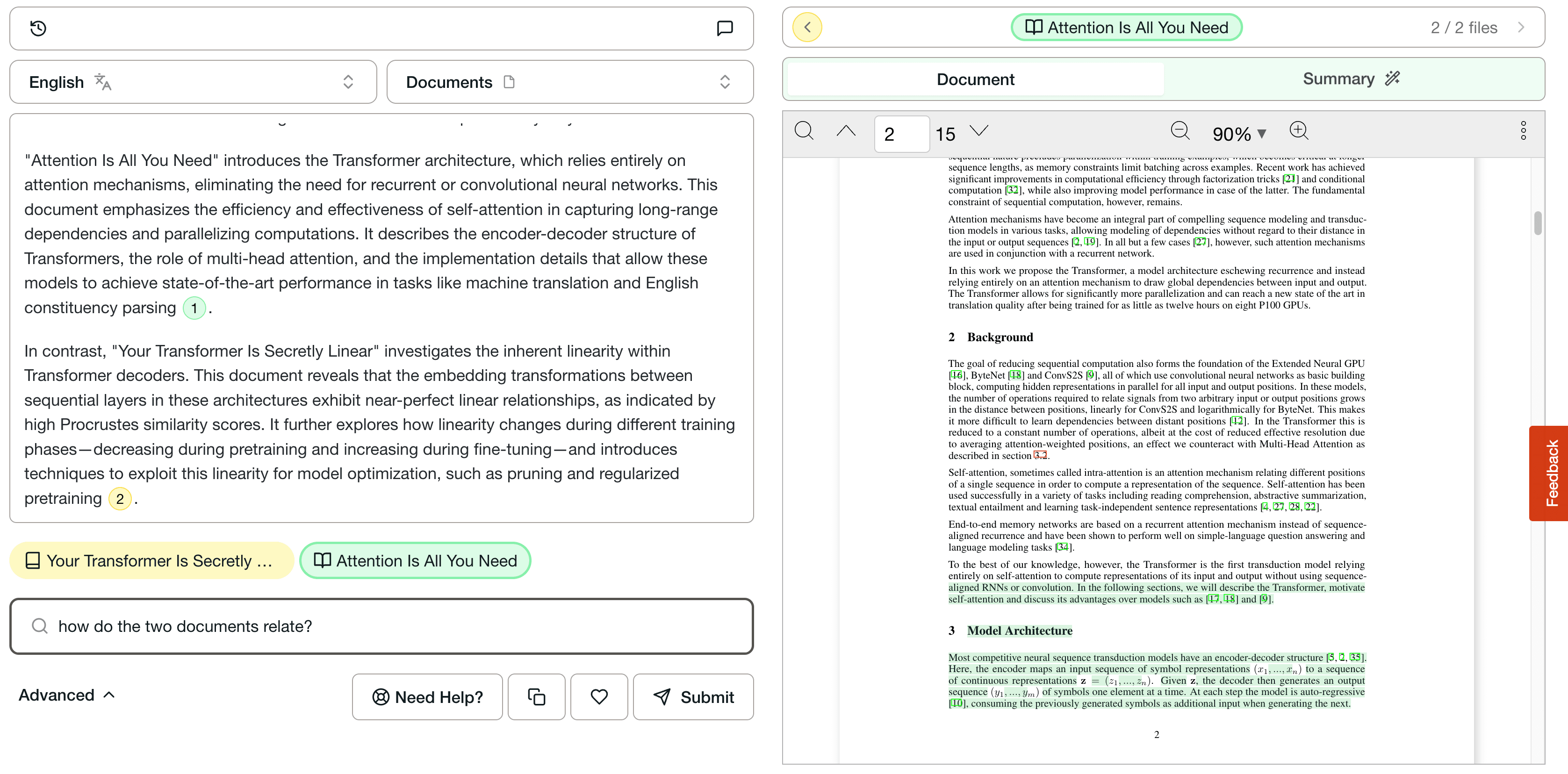
| Can you verify the answer before paying? | Coral AI's published materials describe page citations. Current access terms need checking. | Yes. The public trial produces clickable inline citations that open the supporting passage. |
The Coral AI price conflict is material. PulseSignal's Coral AI pricing record says the Executive plan starts at $12 per month when billed yearly and reports a two-file free tier. SourceForge's Coral AI listing lists $30 per month and a free version. Neither is the current official checkout, so neither should be treated as definitive.
DocuAsk's figures come from the current DocuAsk pricing page. The pioneer prices shown there are $14.99 monthly for Archive Alchemist and $24.99 monthly for Quantum Quill. Paying yearly reduces the displayed monthly equivalents to $12.49 and $19.99. New paid subscribers receive a 15-day trial, with a card required.
The practical difference between the two tools
Both products are designed to reduce the time spent searching long files. The important difference is not whether each can produce an AI answer. It is how easily you can check that answer and how well the workflow fits the material you have.
Coral AI's published product pages describe a broad file assistant. Its audio transcription guide says it can work with PDFs, Word files, presentations, ebooks, web pages, audio, and video. The same guide describes page-number references, search across uploaded files, transcription, OCR for scanned PDFs, and document support in more than 90 languages.
DocuAsk is focused on cited question answering, summaries, search, and comparison across document collections. In the public trial, you provide a public PDF, ask a question, and receive an answer with inline citations. Selecting a citation opens the source page and highlights the supporting passage. The signed-in workspace supports PDF, DOCX, TXT, PPTX, and XLSX files.
The fastest way to decide is to start with your input. Coral AI may be the more relevant product to test if audio, video, ebooks, scanned handwriting, or very broad language coverage is central to your work. DocuAsk is the more direct product to test if your priority is a no-signup PDF proof, inline evidence, and repeated research across papers, reports, or filings.
How citations compare
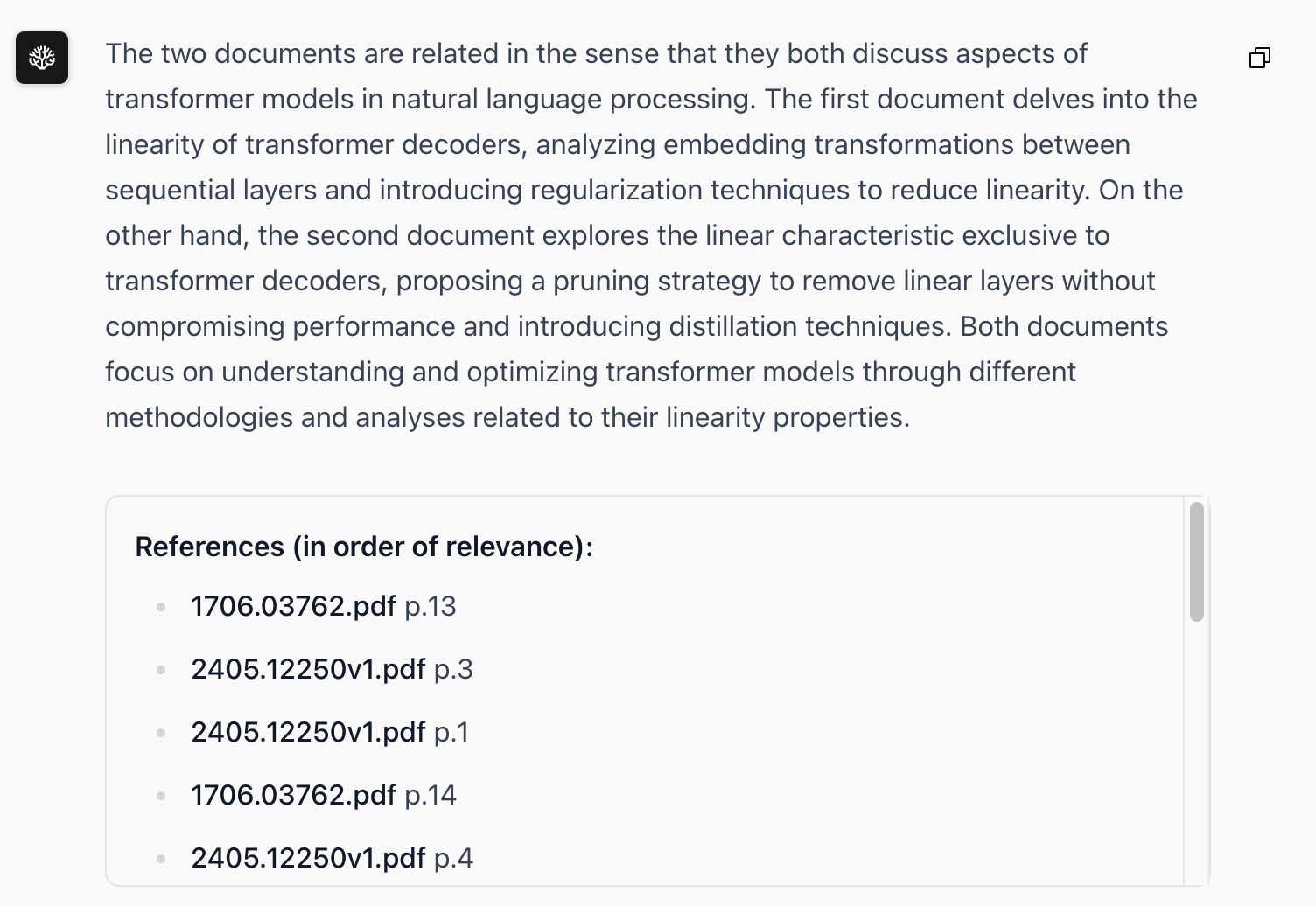
For document analysis, a citation is only useful when it shortens the route from a generated claim to the original evidence. A bare page list can tell you where the system looked. An inline citation can show which source supports a particular sentence.
Coral AI's published materials say its answers include page citations, and an older product screenshot shows reference pages listed after an answer. The screenshot below was captured during our July 2024 review. It is included to show the reference pattern we observed then, not to claim the current interface is unchanged.
DocuAsk places numbered citations beside the claims they support. Each source document receives a color, and selecting a citation opens that document at the relevant highlighted passage. This is especially useful when an answer combines findings from several files, because the evidence stays tied to the sentence rather than appearing as one undifferentiated reference list.
That interface does not make an AI answer automatically correct. Retrieval can miss evidence, a generated sentence can overstate its source, and a citation can point to a passage that only partly supports the claim. With either product, open the source, read the surrounding text, and check whether the answer preserves qualifications, dates, and units.
Public trial access and paid workspace access
Pricing matters, but testability often matters first. A cheap product is still a poor fit if you cannot prove it works on a representative document.
DocuAsk separates the public proof path from the paid workspace:
- The public PDF trial needs no account or payment card.
- You provide a direct URL to a public PDF.
- DocuAsk processes the file and lets you ask a question.
- The answer includes clickable citations to the original pages.
- If the result fits your work, you can consider the 15-day card-backed workspace trial.
The paid workspace adds persistent document storage, multi-document questions, folders, summaries, comparisons, and higher monthly capacity. Archive Alchemist includes 30 document uploads and 300 questions each month. Quantum Quill includes 500 uploads and 10,000 questions each month, along with larger files and the advanced toolset.
Coral AI's current signup and checkout flow could not be independently tested during this review because its main domain did not resolve from our connection. Recent third-party records describe both a free tier and an Executive plan, but the reported limits and prices are not consistent enough to quote as current terms. Before choosing Coral AI, check four items at checkout: the charge today, the renewal amount, whether the displayed monthly figure is billed annually, and the file or transcription limits on the selected plan.
Document types and research workflows
The two products overlap on PDFs, Office documents, natural-language questions, and source references. Their edges point toward different use cases.
When Coral AI's broader input support matters
Coral AI's published materials describe support for audio and video transcription, ebooks, websites, scanned PDFs, handwriting OCR, and more than 90 document languages. That breadth can matter if your source collection mixes lecture recordings, books, scans, and written documents.
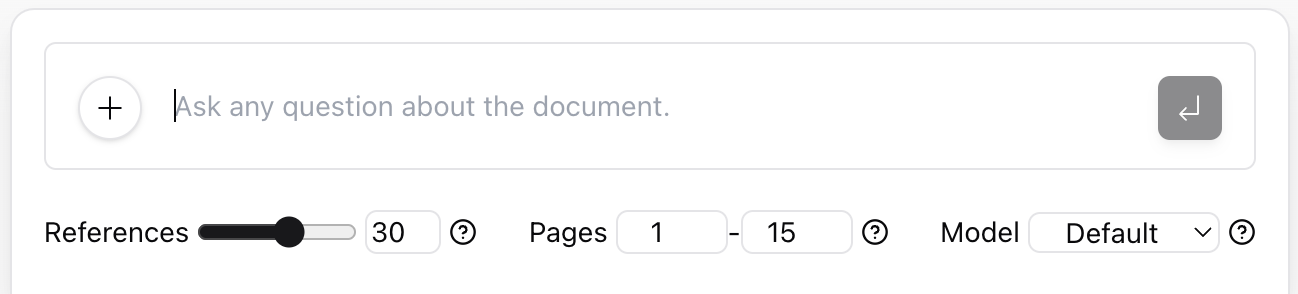
An archived Coral AI screenshot from our 2024 review also showed page-range controls. Narrowing a question to a defined section can be useful when a file repeats terms across chapters or when you want a summary of one part only. The current interface may differ, so confirm this control during your own trial.
When DocuAsk's evidence path matters
DocuAsk is designed for readers who need to find and verify facts inside documents. A researcher can ask how two papers define the same outcome, an analyst can pull a risk factor from a filing, and a market researcher can compare claims across reports. The interface connects each answer to the supporting page so the reader can inspect the evidence without manually searching every file.
For a concrete example, the research-paper comparison workflow shows how to define shared fields before comparing studies.
Which product is easier to evaluate?
Use the same test pack for both tools. A fair comparison needs more than one easy question.
Choose a public or non-sensitive document you already understand, then prepare:
- One direct fact question with an exact answer in the source
- One question whose answer depends on a footnote or qualification
- One question that requires two passages from different pages
- One question the document does not answer
- One comparison question, if the product lets you work across files
Score each result on four dimensions. First, did the answer preserve the source's meaning? Second, did every important claim have a citation? Third, did the citation open the right passage? Fourth, did the tool admit when the document lacked evidence?
Do not score fluency as accuracy. A smooth answer with weak evidence should rank below a plainer answer with a clear source trail. Also record the time needed to verify each result. The product that saves the most reading time is not necessarily the one that generates fastest. It is the one that helps you confirm or reject the answer with the least friction.
When Coral AI may be the better fit
Coral AI deserves a serious test when your workflow extends beyond ordinary office documents. Its published pages describe audio and video transcription, ebook support, OCR for scans and handwriting, broad language coverage, page-range controls, and page references.
That makes Coral AI a plausible better fit for:
- Students working across lecture recordings, textbooks, and scanned notes
- Researchers whose source archive includes audio, video, ebooks, or older scans
- Multilingual teams that need support beyond DocuAsk's published 20-plus languages
- Readers who prefer end-of-answer page references and section-level context controls
These are product-selection reasons, not endorsements of every current claim. Because Coral AI's main site was unavailable during this check, confirm the exact file support, limits, pricing, and interface in the current product before committing annual spend.
When DocuAsk may be the better fit
DocuAsk is the stronger candidate to test when the job begins and ends with evidence inside documents. Its differentiator is not just answering a question. It is keeping the answer close to the passage that supports it.
DocuAsk may be the better fit for:
- Researchers comparing methods, findings, and limitations across papers
- Analysts extracting figures, risks, and definitions from reports or filings
- Teams that want inline citations rather than a separate list of source pages
- Buyers who want to prove the core PDF workflow before signup or card entry
- Document-heavy professionals who need persistent folders, summaries, and cross-document questions
The limitation is equally clear. DocuAsk's no-signup proof path is for public PDFs, not private local files, audio, video, or scans. Full workspace access requires a paid-plan trial with a card. If those boundaries do not fit your evaluation process, Coral AI or another tool may be more appropriate.
A buying checklist before you choose
Use this checklist to turn a vague comparison into a decision:
- Verify today's price. Check the amount charged now, the renewal price, the currency, and whether a monthly-looking figure is billed yearly.
- Test a difficult document. Use a real file with footnotes, tables, repeated terms, and at least one missing answer.
- Open every citation. Confirm the cited passage supports the nearby claim and preserves its qualifications.
- Match the input formats. Include the scans, audio, presentations, spreadsheets, or ebooks that appear in your actual workload.
- Check capacity. Compare upload limits, question limits, file sizes, transcription allowances, and storage rules.
- Review privacy terms. Do not upload confidential material until the processing, retention, and access terms fit your obligations.
- Measure verification time. Record how long it takes to reach and confirm a usable answer, not just how quickly text appears.
Coral AI pricing FAQ
How much does Coral AI cost?
We could not verify a current official Coral AI price on 4 August 2026 because its main site was unavailable. Recent third-party listings conflict: one reports $12 per month billed yearly, while software directories list $30 per month. Check Coral AI's live checkout before buying.
Does Coral AI have a free plan?
Recent third-party pricing records report a limited free plan. We could not verify the current file allowance or whether card details are required, so treat those limits as provisional until you see them in Coral AI's current signup flow.
How much does DocuAsk cost?
DocuAsk lists Archive Alchemist at $14.99 monthly or $12.49 per month billed yearly. Quantum Quill is $24.99 monthly or $19.99 per month billed yearly. Both paid plans include a 15-day trial for new subscribers, with a card required.
Can I try DocuAsk without a card?
Yes. The public PDF trial lets you submit a direct link to a public PDF and ask a question without signup or card entry. The paid workspace trial is separate and does require a card.
What is the main difference between Coral AI and DocuAsk?
Coral AI's published materials emphasize broad file support, including audio, video, ebooks, OCR, and more than 90 languages. DocuAsk emphasizes cited analysis across documents, with clickable inline citations that open and highlight the supporting source passage.
Is DocuAsk a Coral AI alternative?
Yes, if your main job is asking questions, summarizing, searching, or comparing written documents with source-linked answers. It is not a direct replacement for Coral AI's published audio, video, ebook, or handwriting-OCR workflows.
The safest next step is a side-by-side test. Use the same document and questions in both products, open every citation, and compare the full cost only after one tool proves it can surface evidence you trust.