

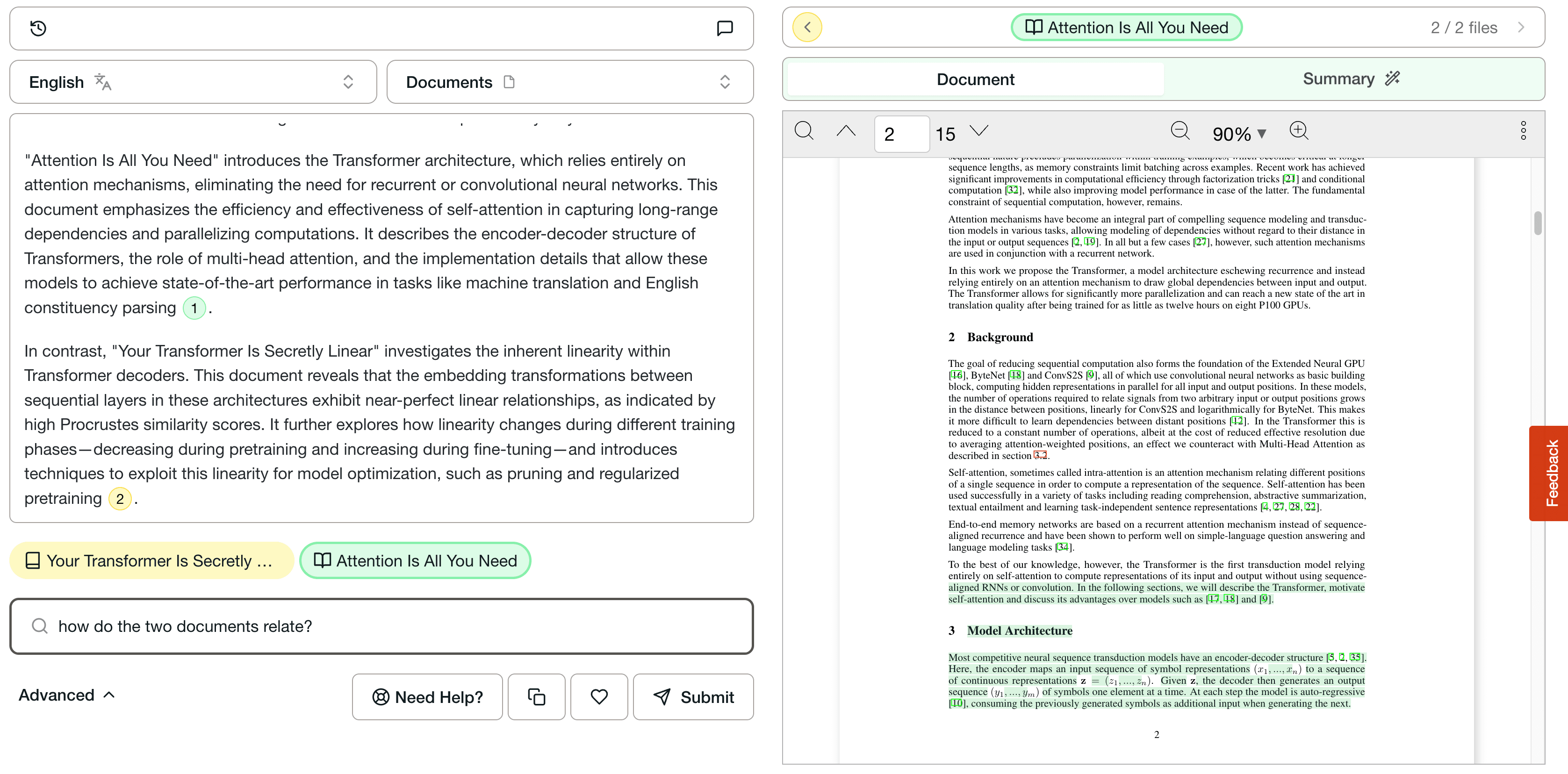
The right AI tool for legal research depends on the source you need. A primary-law research platform helps you find and validate cases, statutes, regulations, and secondary authority. A private-document analysis tool helps you question or compare the contracts, filings, exhibits, reports, or matter files you provide.
Those jobs overlap, but they are not the same. Before comparing products, decide whether you need authoritative legal research, analysis of a closed document set, or both.
Start with the source, not the AI feature
Legal work is unusually sensitive to source coverage, jurisdiction, date, and subsequent treatment. A convincing paragraph is not enough. You need to know where the proposition came from and whether the authority remains valid for the issue at hand.
Use a primary-law research platform when the task begins with an open question about the law. These platforms maintain legal collections and validation systems designed for cases, statutes, regulations, and related materials.
Use a private-document analysis tool when the relevant universe is a set of documents you already hold. Typical jobs include comparing contract language, locating facts across exhibits, summarizing a filing, or tracing a statement to a page in an uploaded document.
A private-document tool is not automatically a legal research database. If it does not provide authoritative source coverage and a citator, do not use it to decide whether a case is good law.
A practical comparison of four tools
This is not a universal ranking. It separates tools by the source base and verification path they officially describe.
| Tool | Best fit | Source and verification path |
|---|---|---|
| Westlaw Advantage | Research across Thomson Reuters legal content | Westlaw combines legal search with KeyCite and describes AI-assisted research that links results to verifiable Westlaw sources. |
| Lexis+ with Protégé | Primary-law and secondary-source research in the LexisNexis collection | Lexis+ describes legal research with Shepard’s citation treatment alongside generative and agentic research workflows. |
| Vincent AI by vLex | Multi-step research and analysis across vLex legal content | vLex’s research workflow produces a cited memorandum from legislation, case law, and secondary sources available to the service. |
| DocuAsk | Questions and comparisons across documents you provide | DocuAsk returns inline citations that open the supporting passage in the supplied document. It is not a primary-law database or citator. |
Product capabilities and coverage change. Check each provider’s current documentation, included jurisdictions, and subscription terms before choosing a platform.
How to verify an AI-assisted legal answer
Treat the generated response as a starting point for research, not the finished work product.
- Open every cited source. Confirm that it exists, belongs to the stated jurisdiction, and contains the proposition attributed to it.
- Read beyond the highlighted passage. Check the surrounding facts, procedural posture, exceptions, definitions, and limiting language.
- Validate current authority. Use the platform’s citator or another appropriate source to review history and treatment. A hyperlink alone does not establish that an authority remains good law.
- Check dates and scope. Confirm the research covered the relevant date range, court level, geography, and source types.
- Look for adverse material. Ask for contrary authority or conflicting document evidence, then verify it independently.
- Preserve the research trail. Record the query, sources reviewed, date checked, and final human decision.
The goal is not merely to catch invented citations. It is also to catch incomplete research, a real source used for the wrong proposition, or an answer that misses a controlling qualification.
Hallucination risk remains a verification problem
Retrieval and citations can reduce some failure modes without eliminating them. A Stanford study of legal retrieval-augmented generation tools found non-zero hallucination rates in specialized legal AI products and emphasized the need for transparent, rigorous evaluation.
That is why a citation should be treated as an inspection route, not proof of correctness. The reviewer still has to decide whether the source supports the claim, whether the authority is current, and whether important contrary material is missing.
For private documents, the same principle applies. A contract summary may point to the right clause but misstate an exception. A chronology may cite a real exhibit but assign the wrong significance to the event. Always review the original material.
Confidentiality and professional responsibility
Before entering client or matter information into any AI service, understand the tool’s terms, security controls, data handling, and access model. Apply the confidentiality and technology-competence duties that govern your practice.
ABA Formal Opinion 512 discusses professional duties implicated by generative AI, including competence, confidentiality, communication, supervision, candor, and reasonable fees. It is guidance under the ABA Model Rules, not a substitute for the rules and opinions applicable in your jurisdiction.
Before adoption, ask:
- Is the document or prompt retained, and for how long?
- Is customer material used to train or improve models?
- Who inside and outside the organization can access the data?
- Can matter-level permissions and deletion requirements be enforced?
- Does the workflow require client disclosure or consent?
- What review is required before AI-assisted work reaches a client or tribunal?
Where private-document analysis fits
A private-document analysis tool can be useful after you have assembled the relevant source set. It can help locate clauses, compare definitions, extract dates, summarize sections, or answer a focused question across supplied files.
DocuAsk’s public PDF trial demonstrates that narrower workflow: provide a public PDF, ask a question without signing up, and receive an answer with inline citations that open the supporting passage. It can help you inspect documents you provide, but it does not validate case history, determine controlling law, or replace legal judgment.
For related workflows, see the guides to asking questions of PDFs, summarizing long reports, and comparing research papers. The subject matter differs, but the verification habit is the same: define the source set, inspect the citations, and check the original document before relying on the answer.
A simple selection rule
Choose the tool by asking one question: Where must the answer come from?
- If it must come from current, authoritative legal sources, start with a legal research platform and validate the authority.
- If it must come from a defined set of private documents, use a document analysis tool with a clear citation path.
- If the task requires both, use both workflows and keep their source boundaries explicit.
No interface removes the lawyer’s responsibility to verify the work. The best tool is the one that makes the relevant sources easier to find, inspect, and document without blurring what those sources can prove.