
DocuAsk for literature review

Compare research papers claim by claim.

Ask one question across selected papers and get a structured comparison with source citations. See where the methods align, where they differ, and which page supports each conclusion.

Try citations on a paper

The public trial starts with one PDF and works without signup.

DocuAsk workspace
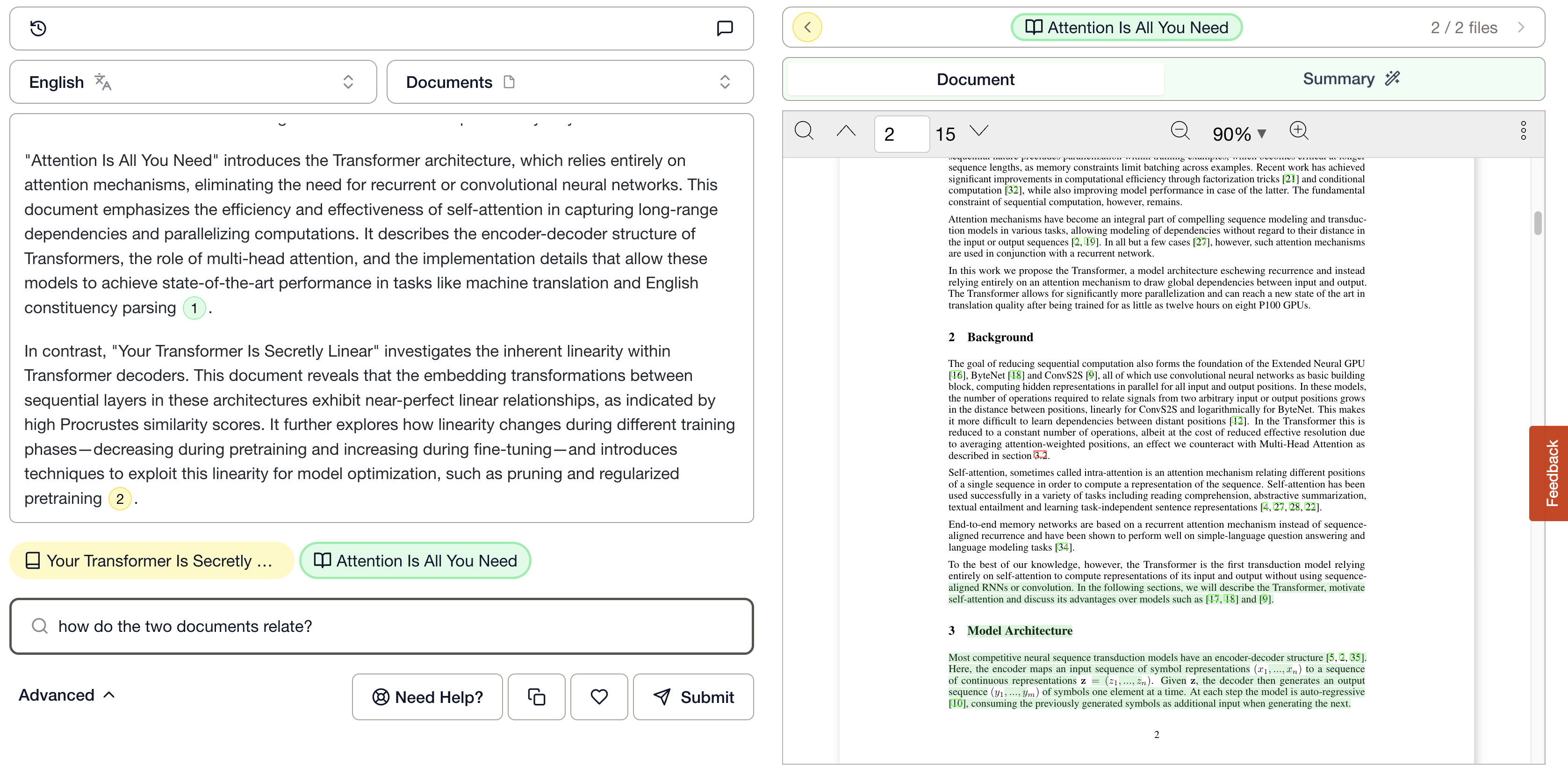
DocuAsk comparing two papers with colour-coded inline citations beside the source PDF

A cited example

Judge the answer by its evidence.

This example uses public source documents. Each finding points back to the exact PDF page so a researcher can verify the wording.

Research question

"How do these papers use the Transformer architecture, and what changes between the original model and BERT?"

The papers are related, but they solve different problems. A comparison should separate the shared architecture from the training objective and downstream use.

The Transformer establishes the architecture

Vaswani et al. introduce an encoder-decoder model based on attention mechanisms, removing recurrence and convolutions from the sequence-transduction architecture.

Attention Is All You Need, PDF pp. 1-2

BERT turns the encoder into a pretrained representation

Devlin et al. pretrain deep bidirectional Transformer representations on unlabeled text, using left and right context across all layers.

BERT, PDF p. 1

The downstream setup changes

The original Transformer is trained for sequence transduction tasks. BERT is designed for fine-tuning, often with one additional output layer for tasks such as question answering and language inference.

BERT, PDF pp. 1-2

A focused workflow

Build the comparison around your research question.

The signed-in workspace can search and ask questions across selected documents. A focused prompt produces a more useful evidence matrix than a broad request to compare everything.

The public trial lets you inspect DocuAsk's cited-answer experience on one PDF. Cross-document comparison is available in the signed-in workspace.

  1. 01

    Choose the papers

    Add the papers to one workspace and select the documents that belong in the comparison.

  2. 02

    Name the comparison dimensions

    Ask about methods, datasets, assumptions, results, limitations, or another question that matters to your review.

  3. 03

    Verify each difference

    Open the cited passage beside the answer so you can confirm the context before adding it to your literature review.

Start with a PDF you already need to understand.

Paste a public PDF link, ask a real research question, and inspect the cited answer before creating an account.

Try citations on a paper